Rinny Perkins (Rinny Riot)
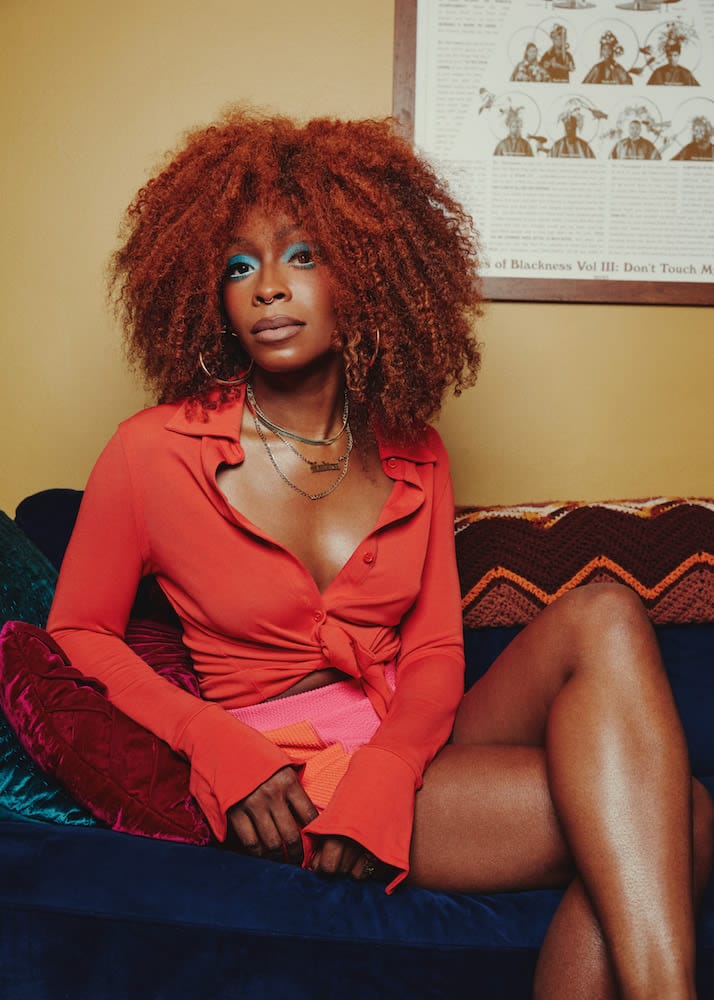
I am aware that this person already has a Wikipedia page, however my aim is to expand and fill in any missing information that underrepresents her.
Rinny Perkins (professionally known as Rinny Riot) is a Los Angeles based comedian, writer, actor, graphic designer and activist (Perkins, n.d.). Although, initially recognised for her comedy and new book ‘Not everyone is going to like you: Thoughts from a former people pleaser’ (Perkins, 2023), she has been highly regarded for her “digital collages” (Gill, 2019b); visually distinctive posters where she integrates humour with retro design, using her comedic influence to highlight the intersections of feminist perspective in black womanhood.
Her work primarily circulates online, as an Instagram-based designer, where she shares her retro inspired poster designs. Through her Instagram she not only posts her designs but also her writing as well as advocating for mental health and racial justice which she has expressed in many interviews (Tamron Hall Show, 2024).
Early Life
Perkins grew up in Houston, Texas (Perkins, n.d.) in a predominantly black neighbourhood, exposing her to an extensive range of black cultural influences. She has described how experiences from friends and family, particularly those who grew up in the 1970’s era of black cultural expression (Morton, 2022), influenced her creative identity and is the foundation of her design work. Growing up in this environment not only exposed her to black culture but also the aesthetics of the era – bold typography and layout of imagery.
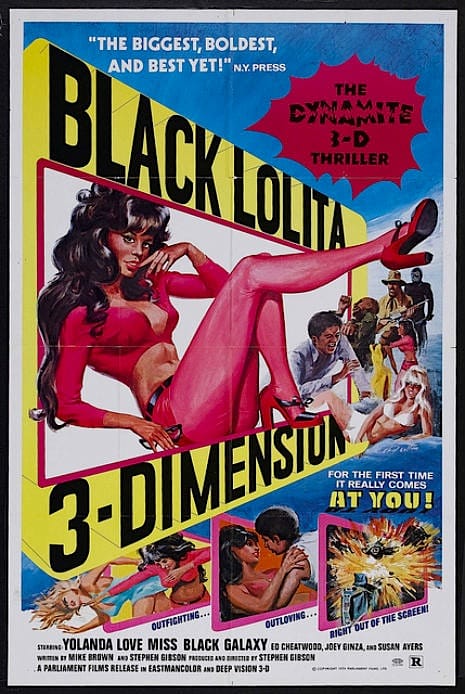
Her design inspiration came from her childhood exposure to Blaxploitation, a subgenre of action “exploitation” films that featured black actors and catered to black audiences, and how this was formative in shaping her visual design choices within her posters. Perkins recalls how these films offered an array of representation for minorities, stating she is “enthralled by how visible representation was at that time” (Into The Gloss, 2021). This visibility is echoed within her designs through the use of archived black imagery (Arauz, 2020), 70’s vivid colours and typography – reflecting Blaxploitation poster design.
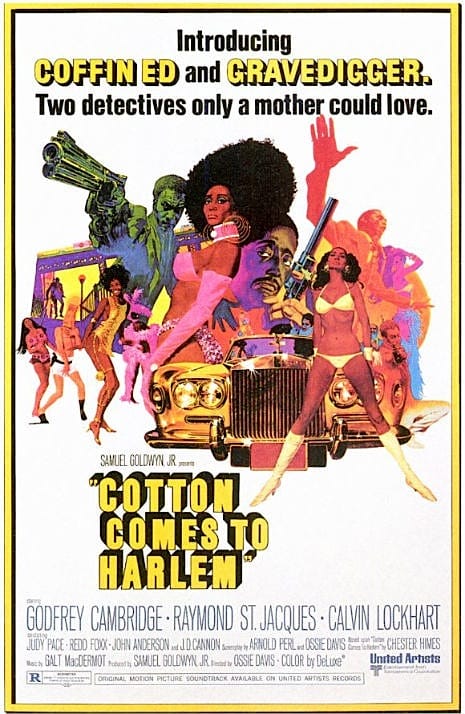
Her childhood experiences are the reason she advocates for black culture and finds representation vital to her poster designs (Arauz, 2020) – using her personal experience and nostalgia to reclaim and bring back black culture within design.
Artistic Themes
Perkins’ aims to create representation and cultural visibility the same way she saw it in her childhood, stating that advertisements were her main way of absorbing messages (Arauz, 2020) .and how they were influential to her. She states that it felt natural to combine 70’s nostalgia with her cultural and feminist messages to create her poster-style digital collages.
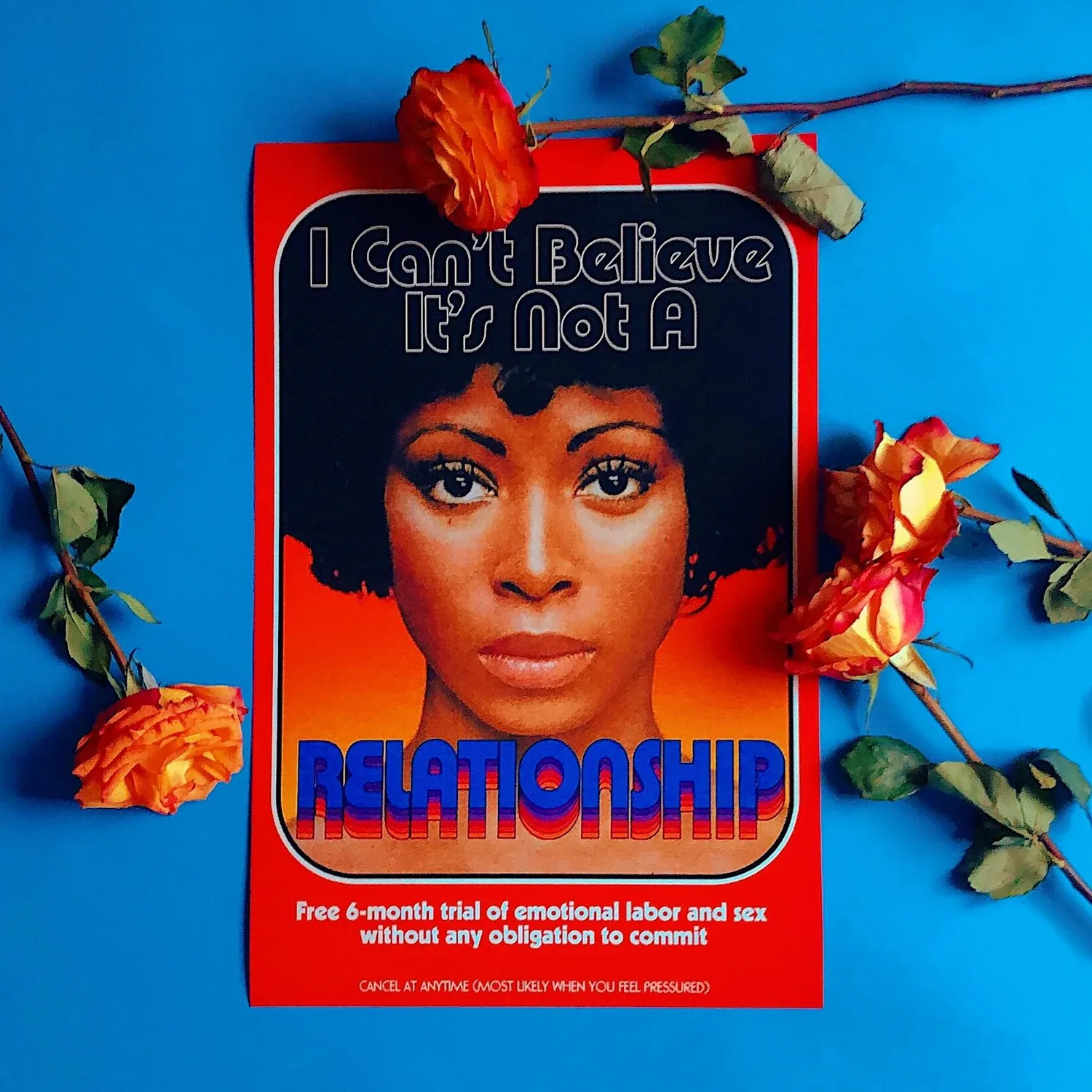
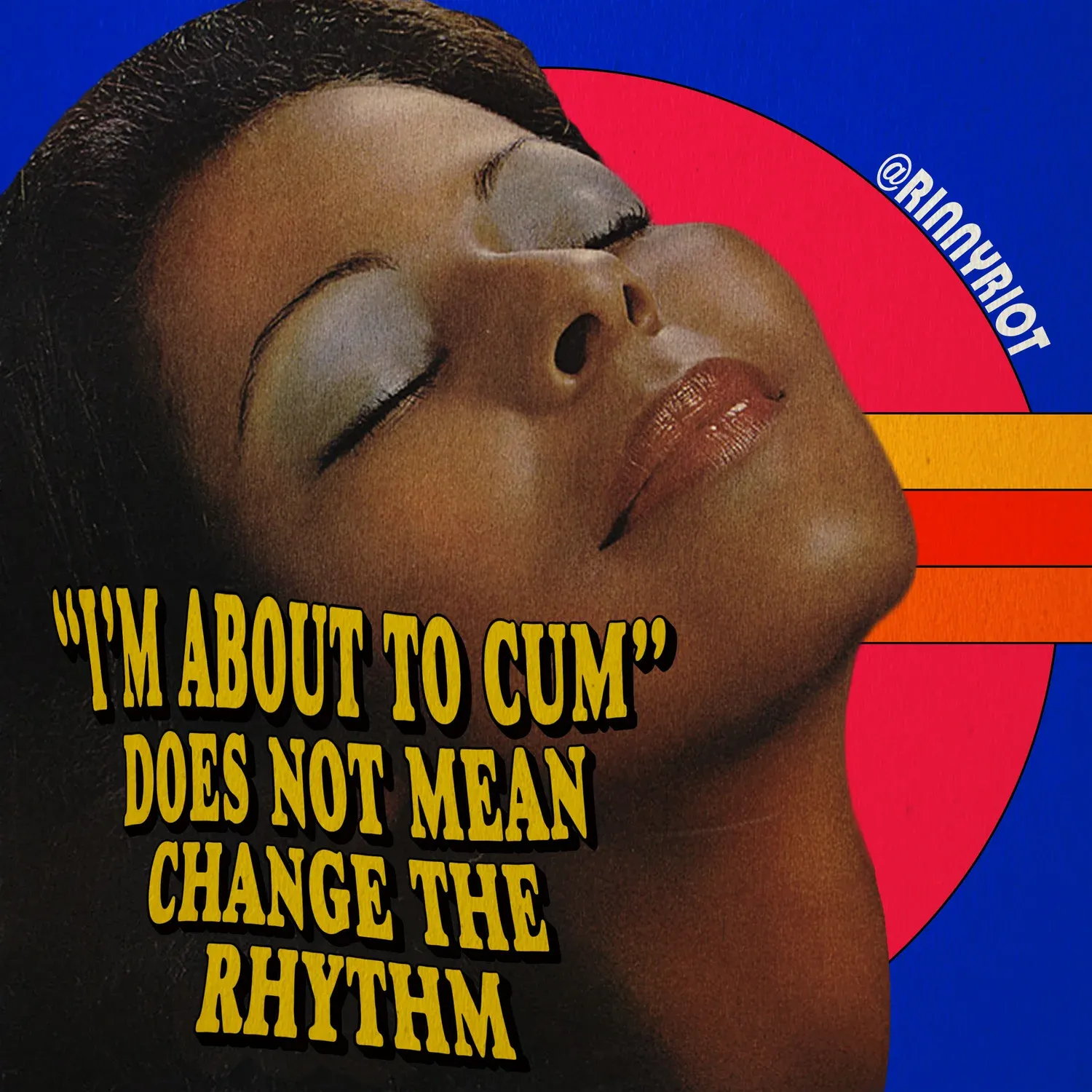
Her design work is defined by her use of retro 70’s aesthetics – bright colour pallets, archived imagery and strong typography – that reflect her cultural influence. She uses era specific photographs of black women at the forefront of her work overlaying them with humorous modern messages that convey her social views that raise important topics surrounding women – sexual autonomy, dating culture and mental health (Gill, 2019b).
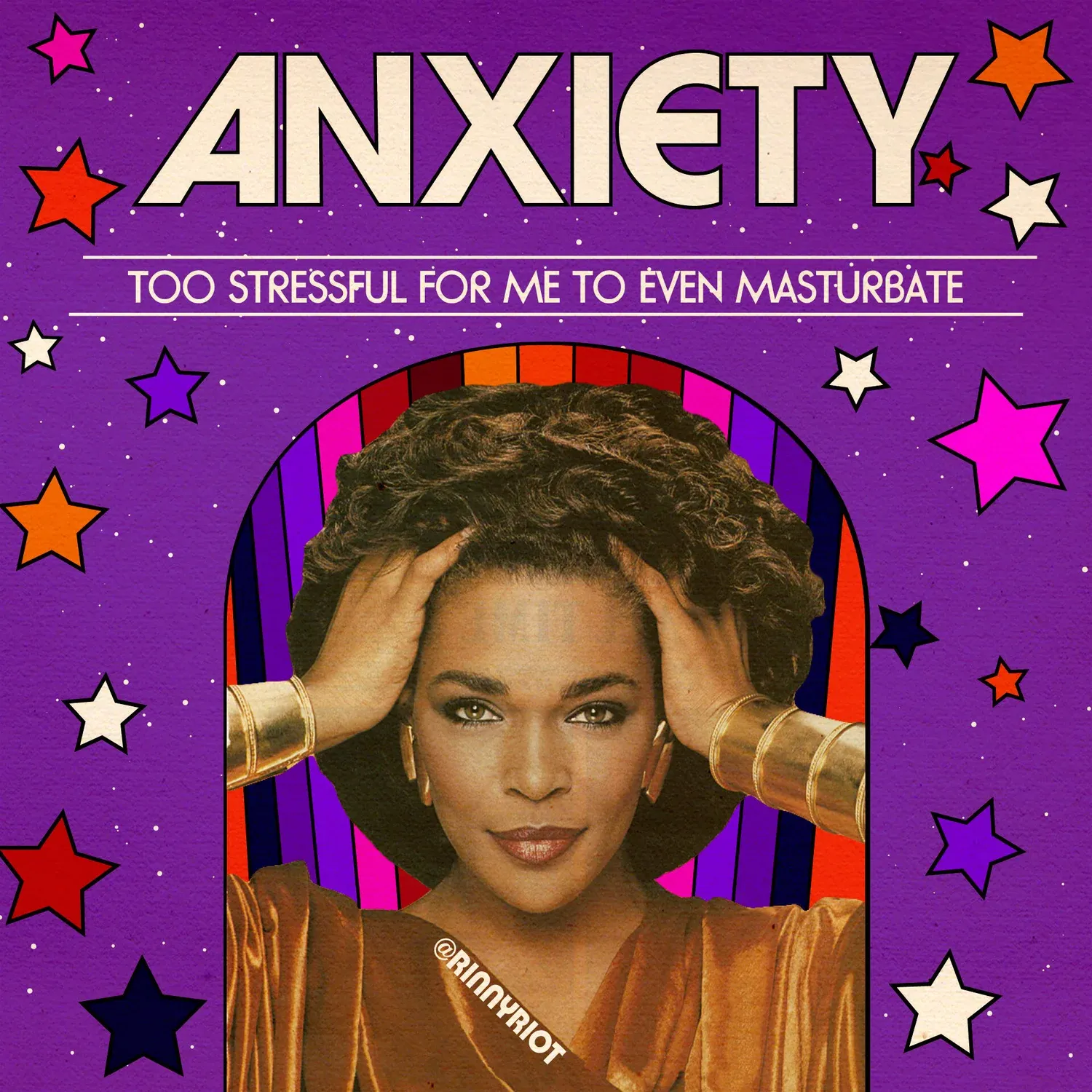
Perkins’ incorporates her societal beliefs along with cultural representation ensuring that her message and voice is heard (Dan White, 2023), using her influence online as an opportunity to add more representation for future generations (Arauz, 2020).
Activism
Perkins’ designs have become a significant part of cultural critique and digital activism since she began to share her collage-based social commentary on Instagram. During the Black Lives Matter protests in 2020, her work gained significant visibility and users shared her work to highlight their allyship and views towards racial justice (Ford, 2020).
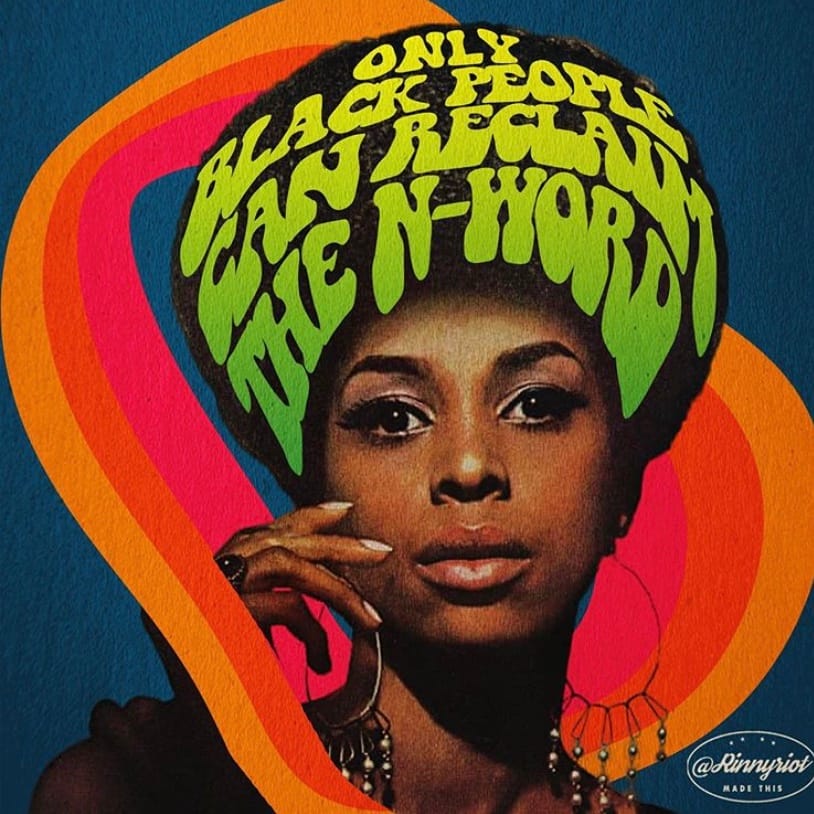
She has consistently expressed how she is an advocate for marginalised voices that tend to slip under the radar – emphasising the importance, as a marginalised individual herself, of reflecting the experiences of minorities who have been overlooked by mainstream culture and media (Morton, 2022).
Rinny Riot and Black Designers
The design sector is consistently and rapidly growing with the market size increasing 7.4% from 2024 to 2025 in the US (nextmsc.com, 2024) and similar statistics being seen in the UK with a 9% growth (Brown, 2024). As of 2023 only 3.4% of US graphic designers are black (Boston, 2023). Throughout history black designers, specifically black women, have been significantly underrepresented within mainstream graphic design – which has long been documented by people and organisations, such as ‘Where are the Black Designers?’ a non-profit organisation which was founded by Mitzi Okou and Garrett Albury in 2020, to make a space for black creativity while decolonising design through education (WATBD, 2020). The date that this organisation was founded correlates directly to the Black Lives Matter movement of 2013 (Wikipedia, 2019) which recirculated on social media in 2020 due to the death of George Floyd (BBC, n.d.). with #BlackLivesMatter becoming a prevalent way of circulating the protests and leaving an opening for black designers such as Brionya J. Matthews, Kambui Olujimi and Rinny Perkins to add their visual social commentary.
Perkins’ work rejects all the constraints that black designers have been subjected to by taking power from her culture inspired by her youth; transforming it into an accessible, shareable posters that subvert Eurocentric design and highlight black representation. With her design work being posted through Instagram the #BlackLivesMatter movement amplified her message and enabled her posters to move beyond traditional design institutions and reach a wider audience.
Black Lives Matter
Perkins’ work gained significant popularity circulating during the Black Lives Matter protests of 2020 with a rise of online activism. Due to the Covid-19 pandemic social media became one of the only ways to stay connected to the wider world and political issues (González-Padilla and Tortolero-Blanco, 2020). Her posters created a foundation for social critique around race and activism that went along with the social-political moment of 2020 – with her designs utilising humour, blunt text and culturally specific messages that highlight the importance of consistent representation for black people specifically black women stating to “use your privilege to do the work. Not just when it’s a trending hashtag. If your activism stops after 48 hours, it’s not activism” (Ford, 2020).
Feminism and Intersectionality
Rinny’s work has always been about intersecting feminism with her culture – pushing her social commentary of how women’s sexual autonomy has been pushed down due to societal expectations and stereotypes. Her work goes alongside Audre Lorde, a pioneer of intersectional feminism, and her idea that age, race, class and sex work together and that “ignoring the differences of race between women and the implications of those differences presents the most serious threat to the mobilization of women’s joint power” (Lorde, 1984, p.117). Perkins herself has stated “I’m a Black woman and you cannot separate the art from the artist.” and has integrated her personal experiences of being a black woman, using humour and expressive language to subvert the stereotype that women should be submissive and instead speaking to black women directly in her own language.
The themes of her posters highlight sexuality, relationships and mental health issues that have often slipped under the radar of design, due to the hierarchy of design being ran predominantly by men. As of 2025 with statistics of design being almost equal within men and women (www.careerexplorer.com, 2025), however roles remain unevenly distributed with 17% of women in design leadership positions (Kerning The Gap, 2020) – Perkins has taken hold of an opportunity to push against the imbalance by focussing her designs on feminist ideals that mainstream design often fails to view as important, offering representation that women don’t often see.
Decolonising Design
Perkins’ visual language - use of retro typography, Blaxploitation aesthetics and archived photographs of Black women in her poster designs – are prevalent in decolonising design.
Her choice to use nostalgia in her designs is not just for stylistic purposes, but to reclaim black culture from her heritage that has been shadowed by Eurocentric design choices. As stated, “decolonising design means putting indigenous first in your decisions” (Tunstall, 2023, p.15) restoring erased cultural heritage and resisting Eurocentric design, which Perkins has consistently done by using black womanhood as her focus and creating further representation for future generations to look back on.
Bibliography
Perkins, R. (n.d.). [online] Rinny Perkins. Available at: https://www.rinnyriot.com
Perkins, R. (2023). Not Everyone Is Going to like You by Rinny Perkins: 9780593325537 | PenguinRandomHouse.com: Books. [online] PenguinRandomhouse.com. Available at: https://www.penguinrandomhouse.com/books/668951/not-everyone-is-going-to-like-you-by-rinny-perkins/ [Accessed ].Perkins, R. (n.d.). About. [online] Rinny Perkins. Available at: https://www.rinnyriot.com/about-1.
Gill, J. (2019b). Houston-born Artist Weaves Childhood Memories into Retro Images with a Snarky Message. [online] Chron. Available at: https://www.chron.com/news/houston-texas/houston/article/Houston-born-artist-weaves-childhood-memories-13750906.php.
Tamron Hall Show (2024). These Books about Ignoring Everyone to Become Your Best Self Are Must-Reads! [online] YouTube. Available at: https://www.youtube.com/watch?v=GDOB4wPSiUk.
Into The Gloss. (2016). Comedian, Writer, Visual Artist Rinny Perkins. [online] Available at: https://intothegloss.com/2021/10/rinny-perkins-beauty-routine.
Arauz, L. (2020). Black with a Capital ‘B’. [online] Office Magazine. Available at: https://officemagazine.net/black-capital-b.
Morton, A. (2022). This Visual Artist Is Brining Awareness to Black Women’s Equal Pay. [online] BET. Available at: https://www.bet.com/article/2e8bh8/black-women-equal-pay-day-money-wealth.
Ford, S. (2020). Art & Protest: Creatives Respond to Racism & Police Brutality - V Magazine. [online] V Magazine. Available at: https://vmagazine.com/article/art-protest-creatives-respond-to-racism-police-brutality/.
Gallagher, P. (2014). Feast Your Eyes on These Awesome Blaxploitation Movie posters! [online] Dangerous Minds - the Weird Side of Underground Culture. Available at: https://dangerousminds.net/comments/feast_your_eyes_awesome_blaxploitation_movie_posters/.
Padjemi, J. (2019). 9 Girls to Follow on Insta’ for Their Style AND Ideas. [online] Tapage. Available at: https://www.tapage-mag.com/mode/9-activistes-mode-a-suivre-sur-instagram.
nextmsc.com. (2024). Graphic Design Market Size and Share | Statistics – 2030. [online] Available at: https://www.nextmsc.com/report/graphic-design-market.
Brown, J. (2024). Twenty-One Twelve | UK Interior Design and Creative Recruiter. [online] Twentyonetwelve.com. Available at: https://www.twentyonetwelve.net/blog/57609g2vckk8dvs61b19zud003ec4g.
Boston, T. (2023). Diversity in Design: Celebrating Black History Month. [online] Awesomic.com. Available at: https://www.awesomic.com/blog/diversity-in-design-celebrating-black-history-month.
WATBD. (2020). Where Are the Black Designers? [online] Available at: https://www.watbd.org.
BBC (n.d.). KS2 Assemblies: The death of George Floyd and the Black Lives Matter movement. [online] BBC School Radio. Available at: https://www.bbc.co.uk/teach/school-radio/articles/zxcvn9q.
Wikipedia (2019). Black Lives Matter. [online] Wikipedia. Available at: https://en.wikipedia.org/wiki/Black_Lives_Matter.
González-Padilla, D.A. and Tortolero-Blanco, L. (2020). Social Media Influence in the COVID-19 Pandemic. International Braz J Urol, [online] 46(1). doi:https://doi.org/10.1590/s1677-5538.ibju.2020.s121.
Tunstall, E. (2023). Decolonizing Design. [online] Google Books, MIT Press, p.15. Available at: https://books.google.co.uk/books?hl=en&lr=&id=2cFvEAAAQBAJ&oi=fnd&pg=PA8&dq=decolonising+design+involves+restoring+erased+cultural+lineages+and+resisting+Eurocentric+standards&ots=XZ7tXO1uJ0&sig=1qs8xr_vuHXs8EL8i9OuXNXXb1A#v=onepage&q&f=false.
Lorde, A. (1984). Age, Race, Class, and Sex: Women Redefining Difference. [online] Sister Outsider: Essays and Speeches, New York: Crossing Press, p.117. Available at: https://www.roosevelthouse.hunter.cuny.edu/devdev/wp-content/uploads/2021/03/AudreLorde-Writings3.pdf.
www.careerexplorer.com. (2025). Graphic Designer Demographics in the United States - CareerExplorer. [online] Available at: https://www.careerexplorer.com/careers/graphic-designer/demographics/.
Kerning The Gap (2020). Kerning the Gap. [online] Kerning the Gap. Available at: https://www.kerningthegap.com.