Nnena Kalu
About Nnena
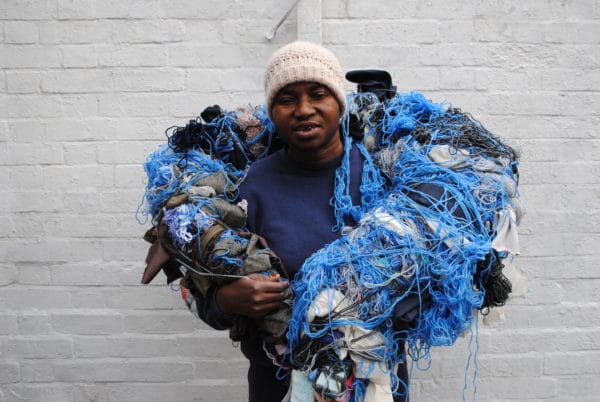
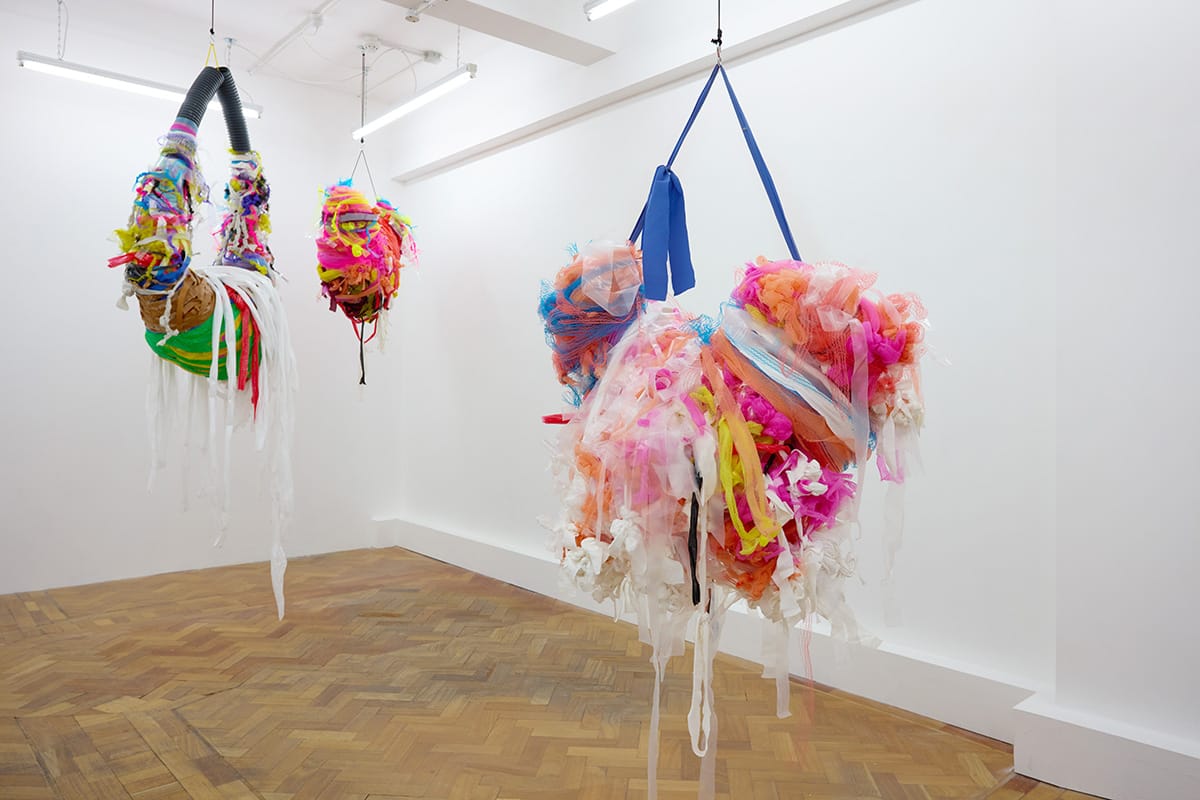
Nnena Kalu is an artist born in Glasgow in 1966 to Nigerian parents, but moved to Wandsworth, London at a young age. She has autism, limited verbal communication and learning disabilities. Working with a studio called ActionSpace, she has been developing her artistic practice since 1999, where she became the first learning disabled artist to be nominated for the Turner Prize award (The Guardian, 2025). Best known for her large-scale sculptural installations, she also created two-dimensional abstract drawings. To make her ‘cocoons’, she uses materials that she has found or have been donated, including fabric, VHS tape, yarn, string, cardboard, and tape (Lisa Slominski, 2020). Kalu’s work is recognised for its immersive presence and its recognition that meaning is produced through physical engagement with materials (Lisa Slominski, 2020).
Kalu often reworks her installation in front of visitors, allowing the viewer to see their slow accumulation and the dynamic energy behind her making (Ella Fleck, 2020). Rather than representation, her work focuses on the rhythm and movement of her process, and how simple materials can be transformed into dense, sculptural environments (Lisa Slominski, 2020). Not only has she become a recognised figure in the field of inclusive and supported studio practice, but she is also broadening the landscape of who gets to be an artist and how artists come into the field beyond the traditional art school route (Elephant, 2020).
Early Life
Nnena Kalu, now 42, began developing her practice in supported studio programmes for neurodivergent artists. Early in her career, she came into contact with ActionSpace, where she has built a relationship that has been instrumental to her work.
It was within ActionSpace’s studio environment that Kalu developed the highly repetitive, process-based mode of working that is so characteristic of her practice today. Her early work consisted of tightly bound paper forms and wrapped bundles of found materials that reflected a strong interest in layering and the physical construction of volume (Lisa Slominski, 2020). Kalu would often work intensely for extended periods of time. Her progression from small-scale experiments to large-scale site-specific installations is a clear demonstration of the possibilities of supported practice models within contemporary art.
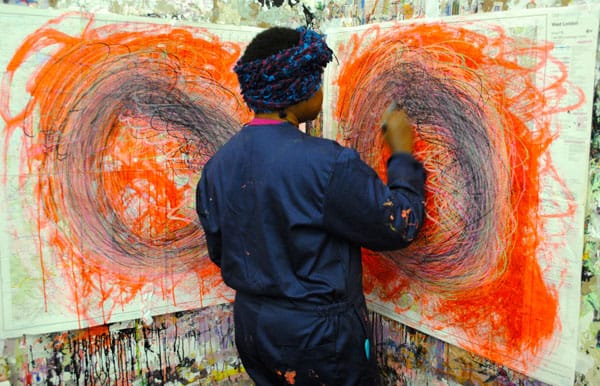
Nnena Kalu’s drawings, like her sculptural work, grow out of a physical, process-driven practice. Her arms moving in rhythmic, repetitive motions, she builds them into enormous accumulations of line and movement. The span of her arms and reach of her body determine the scale of each drawing. She also makes many works in pairs, echoing or answering one piece with another, emphasising her interest in doubling (ActionSpace).

Projects
Kalu had the opportunity to put her creative ideas into action throughout the UK and with her process-based installations, she has been able to exhibit her works in different galleries, museums, and festivals that are committed to experimental and inclusive art-making. She has participated in exhibitions at ActionSpace where she is usually featured as a main artist with her transforming sculptural designs due to their size and power. Some of her works were exhibited in places like Studio Voltaire, London, where she did her several on-site installations and Humber Street Gallery, where she displayed a vast installation that pointed out her fascination with growth, density and the piling up of the material.
A sample of Nnena Kalus recent exhibitions: TUBE LINES, Tate Exchange, Tate Modern, London (2019),Spectrum Arts Prize, Saatchi Gallery, London (2018); Glasgow International, Project Ability, Glasgow (2018); Spring Syllabus, J Hammond Projects, London (2018), Capharnaum, Theatre de Liege, Le Madmusee, Liege (2016),The Trouble with Painting Today, Pump House Gallery, London (2014), (Lisa Slominski, 2020).
Argument
Nnena Kalu’s underrepresentation in the contemporary art scene is a mirror of the structural barriers that challenge neurodivergent and learning-disabled artists, whose work is of high quality and critical significance, but still, these barriers continue to exist. Kalu, despite her uniqueness that has been recognised more and more in the last couple of years and a career that has lasted for over twenty years, is less talked about in the mainstream of the contemporary art world than artists with similar works.
First, mainstream cultural organisations often lack the knowledge, access structures, and commissioning practices that would enable them to include disabled artists on an equal footing. Transnational research commissioned by the British Council ("Time to Act" project) found persistent gaps in sector knowledge and confidence that prevent disabled artists from participating equally in cultural life; many organisations reported that they rarely or never present work by disabled artists. These systemic gaps make it harder for artists who work in supported conditions like Kalu at ActionSpace to access the same program pipelines as peers who follow conventional institutional routes (British Council, 2023).
Second, data compiled by national arts funders and industry groups evidences that disabled people are under-represented in the staffing, leadership and partner institutions that set artistic agendas. Arts Council England's equality and diversity data and related reporting shows low proportions of disabled people in senior roles and across major partner museums - a disparity echoed in reporting by the Museums Association and national press. When curatorial and acquisition power structures lack disability representation, priorities and practices that would normalise learning-disabled artists in mainstream exhibitions and collections are less likely to develop (Arts Council, 2021).
Third, the framing of disability-led or supported-studio practices by institutions and the media can limit critical integration. While vital to questions of access and advocacy, the labelling of programmes, festivals and artists' work as “outsider” or community arts can silo artists by placing their work in separate curatorial categories rather than embedding it within the broader critical conversations about materiality, process, and sculpture. Critics and institutions have at times celebrated Kalu's energy and method without situating her work within longer art-historical discussions of repetition, material practice, and installation — a gap that reduces the likelihood of repeat institutional acquisition and canonical positioning (The Arts Newspaper, 2022).
One of the most compelling indicants of Kalu's underrepresentation is the fact that until her shortlisting in 2025, she had never previously been recognized by the Turner Prize. It is this very year that marks a watershed in nominations, as she is the first ever learning-disabled artist to be shortlisted for the award. It is this late recognition that has underlined how rare it has been for artists working within supported or neurodivergent-inclusive frameworks to reach the highest levels of institutional acclaim. That her voice only now rises to this level-after over two decades of creative work-underscores entrenched structural barriers wherein, despite producing work of equivalent ambition and relevance, learning-disabled artists like Kalu have been long excluded from the mainstream spotlights. Her nomination thus operates both as celebration and as indictment-a stark reminder that until very recently, the parameters of "worthy" contemporary art systematically excluded significant swathes of practice (The Guardian, 2025).
Finally, while recent media coverage and institutional moves — including acquisitions by Tate and a high-profile Turner Prize nomination — indicate shifting recognition, these gains are recent and corrective rather than fully structural. The same sources celebrating Kalu's work highlight the exceptional nature of her recognition precisely because it breaks existing patterns — which confirms rather than contradicts the diagnosis of systemic underrepresentation. If Kalu is to stop being the exception, institutions need to pair exhibitions with long-term collecting and commissioning, curatorial writing that integrates her practice with broader debates, and resourcing to make such integration routine rather than remarkable (Tate, 2022), (The Guardian, 2025).
Bibliography
Eddy Frankel (2025), ‘Her need to make is off the scale’: why Nnena Kalu’s Turner prize nomination is a watershed moment for art. Available from https://www.theguardian.com/artanddesign/2025/may/19/nnena-kalus-turner-prize-watershed-glasgow
Lisa Slominski (2020), NNENA KALU. Available from https://slominskiprojects.com/nnena-kalu
Ella Fleck (2020), Nnena Kalu’s Chrysalides of Material Quietly Evolve in Mayfair. Available from https://www.frieze.com/article/nnena-kalus-chrysalides-material-quietly-evolve-mayfair
Elephant (2020), Nnena Kalu Weaves a Wild Web of Sellotape and Wool. Available from https://elephant.art/nnena-kalu-weaves-wild-web-sellotape-wool-studio-voltaire-09032020/
ActionSpace, Nnena Kalu. Available from https://actionspace.org/artists/nnena-kalu/
The British Council (2023), Research Series: Time to Act | Arts and Disability. Available from https://www.britishcouncil.org/research-insight/Time_to_Act_report?
Arts Council (2021), Equality, Diversity and Inclusion: A Data Report, 2020-2021. Available from https://www.artscouncil.org.uk/equality-diversity-and-inclusion-data-report-2020-2021?
The Art Newspaper (2022), Largest ever exhibition of work by disabled artists in uk to be staged by museums nationwide. Available from https://www.theartnewspaper.com/2022/06/28/largest-ever-exhibition-of-work-by-disabled-artists-in-uk-to-be-staged-by-museums-nationwide-including-tate-and-arnolfini-in-bristol?
Eddy Frankel (2025), ‘Her need to make is off the scale’: why Nnena Kalu’s Turner prize nomination is a watershed moment for art. Available from https://www.theguardian.com/artanddesign/2025/may/19/nnena-kalus-turner-prize-watershed-glasgow
Tate (2022), Nnena Kalu. Available from https://www.tate.org.uk/art/artists/nnena-kalu-31633?