5.2.3 - Workflow
What parts of your practice make you feel most engaged and creative?
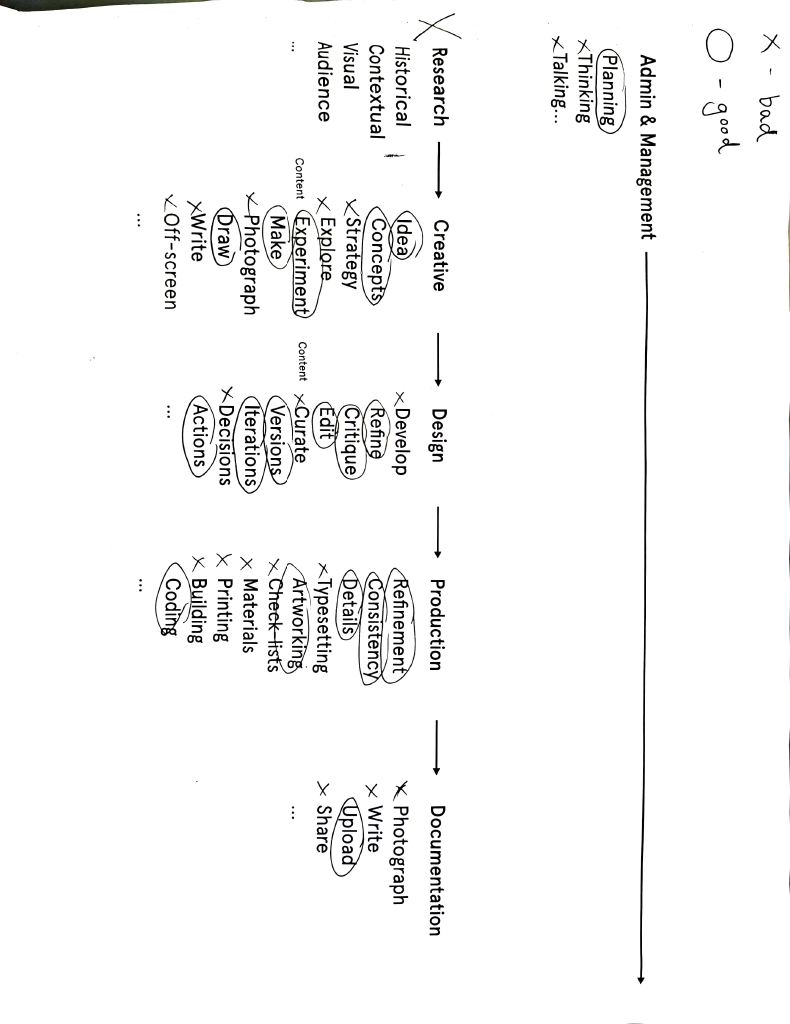
Personally, I’m more excited about experimenting with different styles and iterations of my designs. It allows me to explore much more than I can when I'm thinking about where to start, and most of the time I end up changing it into something way different but way better. I also enjoy refining my work as much as possible after completing the design, allowing me to adjust it according to my evolving ideas, which is enjoyable.
When do you ‘actually’ feel like you’re designing?
Once I get into a flow of doing many different experiments, whether digital or physical, I feel like research really helps a lot. However, I can only focus on one at a time, and spending too much time on research can sometimes limit the number of experiments and designs I can produce within a project. I prefer to focus on designing and get my initial ideas instantly because, most of the time, I like to carry those ideas through to the outcome, developing my process from initial concepts to completed designs, incorporating research along the way.
When I can continually seek feedback from my peers—asking what to improve and what works well—I feel like I’m becoming a better designer and creating what I truly want.
What pain points do you identify in your own workflow?
Research is a tricky part for me. When I’m working on something I really enjoy, it isn’t an issue, and I end up doing quite a lot to support my ideas and workflow. However, at other times, research can hold me back, making it difficult to realise my true ideas and designs because it’s hard to focus on two different aspects at once. It feels like they clash with my own ideas, leading to a messy outcome with no clear direction and sudden jumps from one design to a completely different one.
Another challenge is the starting phase. Most of the projects we’ve completed so far have been enjoyable, but when I get a project, I’m not particularly excited about or one that doesn’t interest me immediately, it can lead to a slow start, a rushed middle, and a poor finish—which unfortunately happens quite often, even with projects I love.
Adding to this, time management ties everything together. Sometimes, when I get lost in a project, I forget important aspects, which results in rushing certain parts and producing a poorer quality overall, ultimately affecting my grade.
What steps or obstacles do you find hinder your designing?
Research again, but also received critiques that my designs aren’t correct. It’s easy for me to accept that I need to change my design and experiment more, resulting in a better outcome. However, when I am told that a design I’m enjoying working on, which I’ve put a lot of effort into, ends up being very different and less satisfying than I hoped, it makes the project less enjoyable. This can carry over into the next project, delaying the completion of something I love.
As I mentioned, research drains my energy. Undertaking extensive research and preparation helps me understand where to start, but it also saps my energy, often causing delays in beginning the actual work. This is usually when my projects slow down.
Part 2: Research tools
What tools, techniques, or strategies have you discovered in your research?
During my experience with graphic design, I’ve found many techniques that significantly improve my workflow and help me achieve better outcomes. Using tools like Grammarly or any other spelling and grammar checker really helps me communicate my ideas more clearly when writing and researching. It feels like my workflow accelerates when I don’t need to worry about spelling mistakes, as I can easily correct them.
It might sound odd, but wearing headphones and picking my nails helps relieve my stress and pressure. I often find myself biting or picking at my nails—mostly out of habit and after years of being under stress from college and university. This habit helps me destress and focus on my work. I’m not sure why, but it’s calming and allows me to concentrate on what's in front of me, more so than I would otherwise.
DitherBoy, or specifically AAA Studio, makes amazing software and designs that can easily beat Photoshop or Adobe. It’s more focused on one aspect and does cost, but if you are interested in certain areas for work or pleasure, then they have a lot of software and extensions to help with workflow and designs.
How could these be integrated into your practice?
I think that the software I found can really help me see the outcome of that idea with software that fits it perfectly. Then it allows me to see and know if that idea is something that I can take into the outcome with the right tools and research with me. Whenever I’m feeling pressured or stressed, using my headphones helps me a lot. Putting on any song without words so it won’t distract me from typing allows me to zone out background noise that distracts me easily.
Part 3: Question
How do emerging tools (including AI) challenge or change what it means to be a designer, and how might your workflow need to adapt?
The problem with emerging tools that use AI is that people will become too reliant and way too expecting from the tools to get the work done. If people don’t understand or try to figure out how these tools do what they do, a lot of the process of experimenting gets lost, as if the tools don’t succeed in the prompt they are given, or the piece of design. Then the designer will get lost, lose motivation and give up on that process without digging deep into the research or process it takes.
I think generative AI CAN help, but do I support it? No. I think a lot of the ideas that people make today are helped with AI, and yes, some can be amazing when they are fixed, changed, and completely remade with the same idea by a HUMAN. But companies and different design places are getting too comfortable with using these designs as their FINISHED outcome. Completely stopping designing to experiment, show different ideas, and have that freedom with their work, when AI is only giving ideas that the AI thinks are right, not what people or the company might want.
I use AI to help me spell check and write sentences, as it just helps that part of the workflow I personally don’t like. But that isn’t taking any of my ideas from the actual brief or project away. It makes that part of typing, spell checking and taking away energy an easy job, which helps me succeed in the end.
With more AI tools, designers will be replaced. No matter how many people tell others or even me that AI is a tool, not an enemy, it just feels wrong. AI for a good while won’t get up to par or give the same ideas as an actual human, but eventually, with how AI is improving, more jobs with designers are getting removed and taken away. Thinking of ideas, doing sketches, processing, all of that will and IS being taken away from people, and they feel forced to use these tools as it’s the new and hot thing.
Tools that don’t include AI, or are SLIGHTLY supported by AI, but don’t take away anything from designs, I’m happy with. I think that in the right areas and the way people use these tools, it can be useful and improve the overall experience with designing.