5.3 Wikipedia entry
Tan Zi Xi
Tan Zi Xi is Singaporean illustrator, who graduated from Central St Martins (CSM) in graphics and communication in 2009[1]. Her work is based on failure, disorder and environmental issues. ‘They can be dark to some extent. I am quite a compassionate person, and my own experiences and encounters are related to these subjects in a lot of ways, which is why they attract me I think”[2].
[1] MESSYMSXI. (2015). A Little About Me. [online] Available at: https://messymsxi.sg/about/?ref=artshelp.com [Accessed 27 Nov. 2025].
2 Khandelwal, P. (2017). Tan Zi Xi. [online] The Floating Magazine. Available at: https://thefloatingmagazine.com/people-tan-zi-xi/.

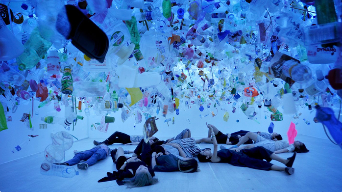
Plastic Ocean installation
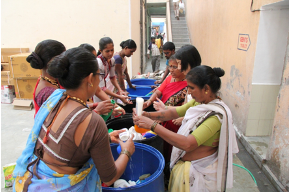
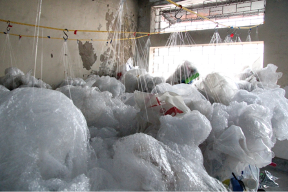
In 2016 installation Plastic Ocean (fig. 1) used over 20,000 pieces of plastic found on coast that were installed from the sealing. The purpose was to embody the floating plastic feeling; she individually sowed the plastic together in the correct height to show movement of the ocean. Her mission is to consider our contribution to the plastic waste in our oceans and find more eco friendlier solutions to plastic. The goal is to “reinforce empathy and consciousness for our underwater creatures,”[1] Tan Zi Xi stated. She also mentioned that each piece in the exhibition take roughly 500 – 1000 years to break down, not to mention it leaves a residue of micro plastics. Which we will eventually consume via water or food (fish), her message to the audience is to take accountability on the behaviours we have towards our planet. But also take accountability for our actions and change our habits to accommodate everyone not just humans. Her ultimate mission she’s trying to achieve is to get visitors to reconsider their everyday contribution to the ocean pollution and find ecofriendly alternatives. “If we humans have already produced more plastic within the past ten years than the whole of the last century,”. Therefore, she is trying to visually embody what our future holds if we are going to carry on at the rate we are now. Her overall objective is to raise an awareness of our actions therefore we can change our ways on plastic waste and live more ecofriendly therefore we can protect our planet and marine life.
[1]Rebelo, M. (2023). Singapore-based artist Tan Zi Xi brings awareness to ocean pollution through her illustrations and one-of-a-kind sculptures. [online] Arts Help. Available at: https://www.artshelp.com/singapore-based-artist-tan-zi-xi-brings-awareness-to-ocean-pollution-through-her-illustrations-and-one-of-a-kind-sculptures/.
Awards:
Tan Zi Xi won the "New Talent of Year 2010" in the London International Creative Competition for her seminal series Ten Years of Work for Every Minute on Stage.
In 2013, Tan Zi Xi was winner of the "Most Inspiring Award" in the Great Women of Our Time 2013, an annual award by The Singapore Women's Weekly that honours the achievements of the nation's most inspiring women.
In 2019, Zi Xi was nominated "40 Under 40" by Singapore Prestige Awards for her distinguished installation and art on Environmental advocacy.
Lastly Tan Zi Xi was awarded Tatler's Gen.T List 2021 as a young leader in the industry.
Argument
plastic
Our oceans are polluted, because it doesn’t only affect the marine life, but it also affects our well being too. The tap water we drink 83%[1] is contaminated with micro plastics and not to mention 1in 3 caught fish[2] also contains micro plastics. I think it’s a serious issue the artist Tan Zi Xi is trying to highlight as many of us go along our days without really thinking what consequences our actions have, hence I think it’s a great way to make us think twice of what we are doing by creating the exhibition and embodying the problem our marine life face today. We can solve this by reducing over half of the plastic usage in restaurants and supermarkets as many items are unnecessarily packaged and can be removed and replaced by alternatives. This adds up to 29.8 billion avoidable pieces across UK (2024). There is also evidence that UK is the largest single-use plastic waste generating countries worldwide (2025) runner up behind US[3]. These statistics shows how unnecessarily over package our food and we could solve this problem by simply packaging plastic where is necessary and use alternatives. As there is also evidence that the snow in arctic also contains microplastics[4] which makes me ask the question isn’t there enough plastic in the world to last for centuries? Like the artist said in an interview, isn’t this evidence enough? To change our habits and reduce plastic.
Oil spill
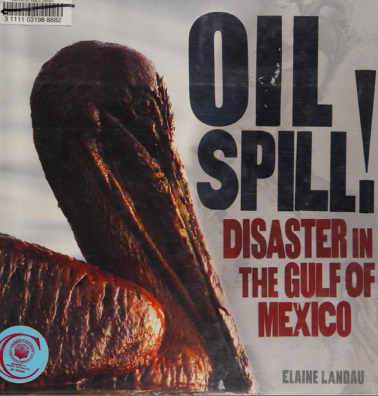
But plastic isn’t the only enemy to marine life so are oil spills[5]. In April 2010 in Gulf of Mexico BP spilled over 3.19 million barrels of oil[6]. Which has left a catastrophic impact on the marine life as almost all 21 species of dolphins live there. Many had injuries and some species have declined over half, for them to recover it will take over century[7]. But there is also ocean floor which of 770 square was covered in oil even other places. which shows that it’s a wider problem than it is talked about. Not only the ocean life was affected but also the land animals like birds which was over 93 species, which creates a knock-on effect on the rest of the food chain. The effects of the spill are still being cleaned up even today (2025), in 2019 they estimated that it will carry on way over 2030. Overall, all the evidence points that if we are not being aware of our habits and start educating everyone we will destroy everything. David Attenborough once said, "If children don't grow up knowing about nature and appreciating it, they will not understand it, and if they don't understand it, they won't protect it, and if they don't protect it, who will?"[8] .I think this is important which also goes back to the artist Tan Zi Xi that we have something very precious and important that needs protecting. We need to raise awareness as we have neglected nature marine/land animals long enough for our selfish and unimportant rezonigs like money, status and power.
[1]Chandra, S. and Walsh, K.B. (2024). Microplastics in water: Occurrence, Fate and Removal. Journal of Contaminant Hydrology, [online] 264, pp.104360–104360. doi:https://doi.org/10.1016/j.jconhyd.2024.104360
[2] Surfers Against Sewage (2025). Plastic pollution: Facts & figures. [online] Surfers Against Sewage. Available at: https://www.sas.org.uk/plastic-pollution/plastic-pollution-facts-figures/.
[3] Surfers Against Sewage (2025). Plastic pollution: Facts & figures. [online] Surfers Against Sewage. Available at: https://www.sas.org.uk/plastic-pollution/plastic-pollution-facts-figures/.
[4] Environment. (2019). Microplastics found in Arctic snow. [online] Available at: https://www.nationalgeographic.com/environment/article/microplastics-found-in-arctic-snow
[5] Wikipedia Contributors (2019). Deepwater Horizon oil spill. [online] Wikipedia. Available at: https://en.wikipedia.org/wiki/Deepwater_Horizon_oil_spill
[6] NOAA (2021). Deepwater Horizon 10 Years Later: 10 Questions | NOAA Fisheries. [online] NOAA. Available at: https://www.fisheries.noaa.gov/news/deepwater-horizon-10-years-later-10-questions.
[7] The National Wildlife Federation (n.d.). Deepwater Horizon’s Impact on Wildlife. [online] National Wildlife Federation. Available at: https://www.nwf.org/oilspill
[8] Media (2000), M. (n.d.). Why we must teach children the wonders of our world | Enabling Environments. [online] Teach Early Years. Available at: https://www.teachearlyyears.com/enabling-environments/view/why-we-must-teach-children-the-wonders-of-our-world.