Anna Wagner
Female neurodivergent ceramicist advocating for invisible disabilities.
Early life and education
Anna Lynette Wagner is a female artist and ceramicist based in Cabot, Arkansas. She is 32 years old, born in 1993 (Spokeo, 2025). Between the years 2012-2014, Wagner completed General Studies at Butler Community College, in Andover, Kansas before attending Arkansas State University- Beebe, in Beebe, Arkansas where she was awarded an Associate of General Studies degree in 2015. Following this, Wagner got a BFA in Ceramics at The University of Central Arkansas, in Conway, Arkansas across 2015-2020. To finish off her education, Wagner got her MFA in Ceramics from The New York State College of Ceramics at Alfred University, in Alfred, New York between 2023-2025 (Alwagnergallery, 2025).
Alongside her education, Wagner participated in two internships- Clay Art Centre, Port Chester, New York in 2019, and Jason Briggs, Rapid City, San Diego in 2020. Furthermore, in 2021 she completed a short-term residency at The Red Lodge Clay Centre, Red Lodge, Montana. (Alwagnergallery, 2025).
Career
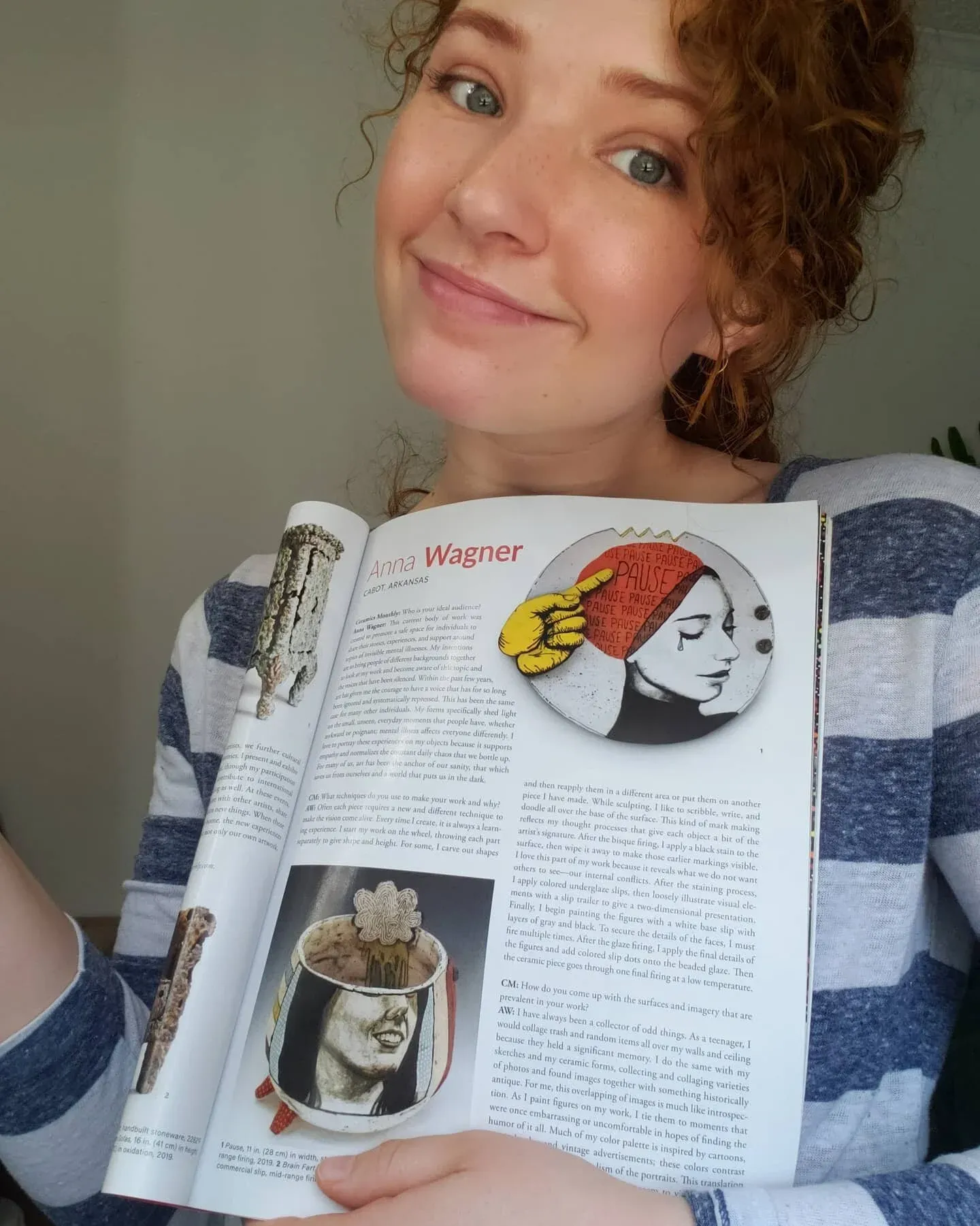
Over six years, 2019-present day, Wagner has completed a decuplet of teaching and work experience. She has been a teaching assistant (TA) four times, with the most recent being a TA for Intro to Visual Arts alongside Eugene Agyei, at Alfred University, in Alfred, New York in 2025. Additionally, Wagner has worked as a Ceramics/ Sculpture Instructor for two institutions, one of which was at The Atelier School of Art, in Sherwood, Arkansas in 2025. Her most recent role, as of 2025, being a Vetter (Curator) - a person that specialises in collecting, researching, preserving and exhibiting pottery and porcelain - at The Museum of Ceramic Art (MOCA) in New York City, New York. (Alwagnergallery, 2025).
About her work
Within her work she aims to reflect upon mental, social and physical experiences associated with neurodivergence. Wagner stated in a podcast that her work “interprets the effects of taking Adderall (attention deficit hyperactivity disorder (ADHD) medication) and stems from the perspective of someone dealing with ADD/ ADHD” (Gise, 2020)
In an interview with Ceramics Monthly (May 2021 issue), Wagner stated that her work was “created to promote a safe space for individuals to share their stories, experiences, and support around topics of invisible mental illnesses” and “to bring people of different backgrounds together to look at my work and become aware of this topic and the voices that have been silenced…My forms specifically shed light on the small, unseen, everyday moments that people have, whether awkward or poignant; mental illness affects everyone differently.” (Ceramics Monthly, 2021)
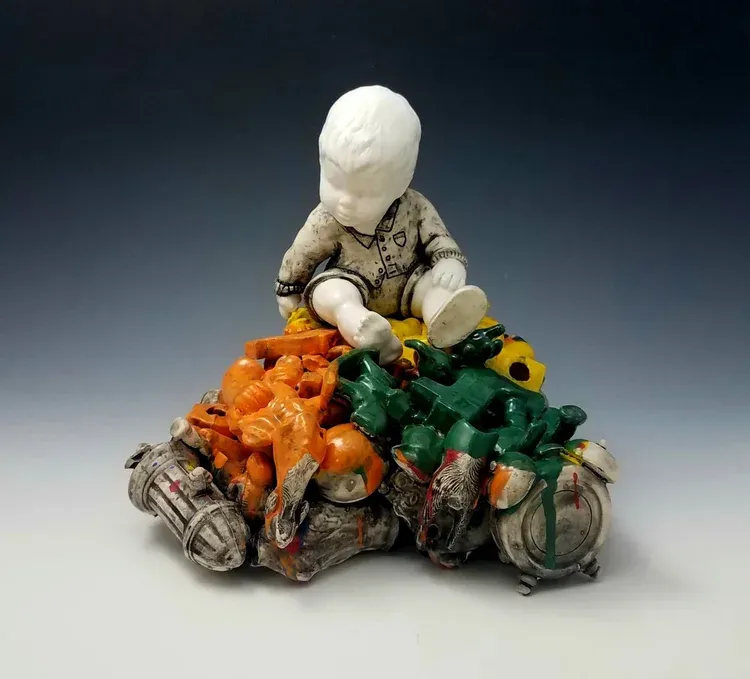
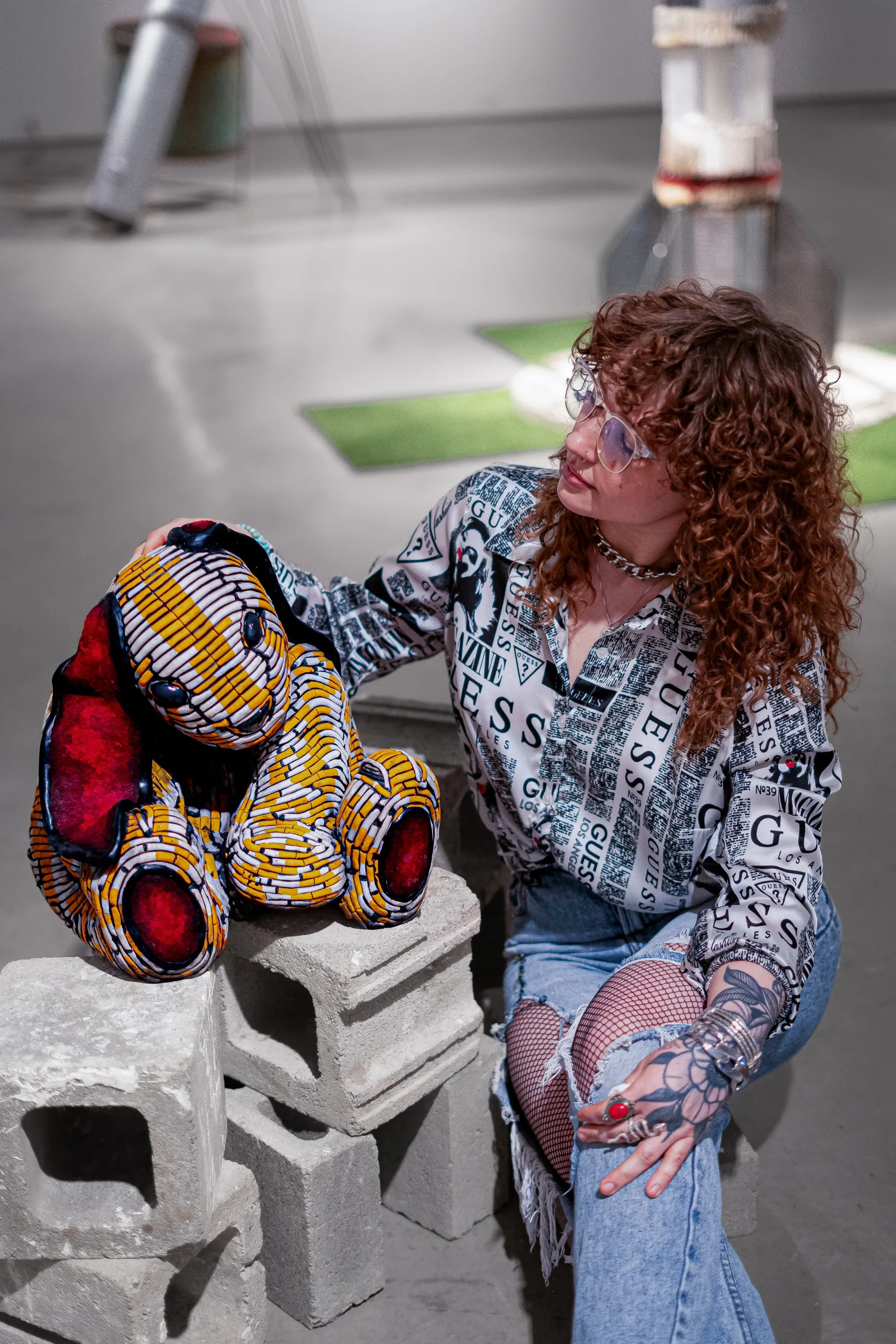
Thus, Wagner takes familiar household objects and reimagines them through clay, transforming them into symbolic vessels that explore gender, neurodiversity, memory and emotional labour. By manipulating and enlarging the shape of the objects, Wagner exposes the emotional weight and narrative behind them; by reframing them, she transforms these once stable, reliable objects into unstable symbolic forms.
In addition, Wagner draws significant inspiration from her own lived experiences, of girlhood, neurodivergent stereotypes and generational caregiving. Thus, as a nod to media such as cartoons reminiscent of her childhood (1990’s), alongside religious iconography, and the incorporation of humour and text, she is able to create these contradictory, psychologically questionable ceramics.
Exhibitions and Recognitions
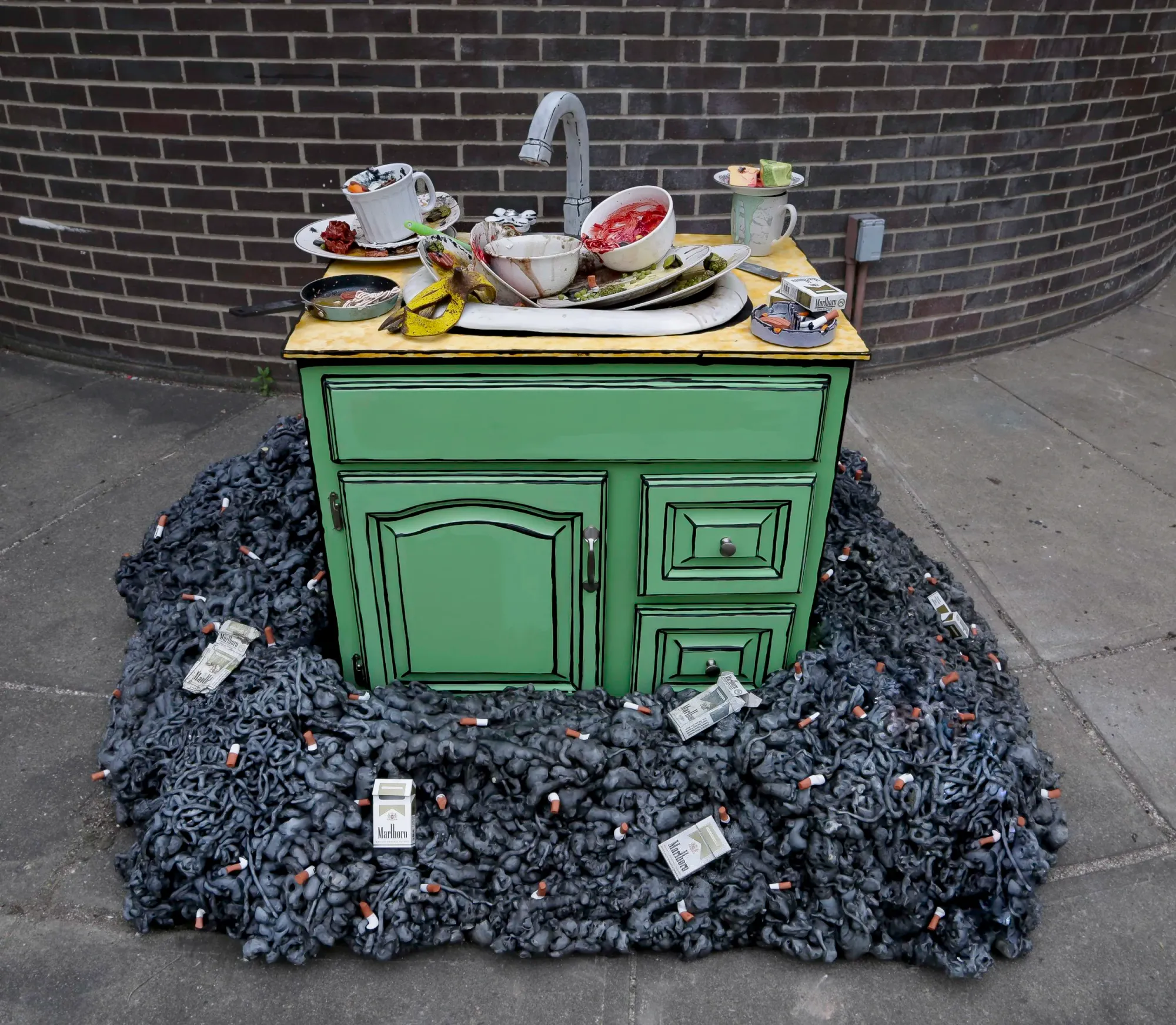
Over the course of her education and career, Wagner has had work displayed across twenty-seven exhibitions, eighteen group, six online, one duo and one solo, with her most prevalent one being her thesis exhibition ‘Life in an Ashtray’, at The New York State College of Ceramics Alfred University, in 2025. (Alwagnergallery, 2025).
The Argument
The absence of representation can directly cause detrimental consequences for an individual’s life. This is because a lack of representation, allows for a lack of education, research and funding, all of which directly contribute to delayed diagnosis and treatments, stigma and often diminishing mental health. Thus, it can be argued that, increasing visible, credible representation of artists such as ceramist Anna Wagner who embodies and advocates for many underrepresented communities, is essential.
According to UK government data, over 20% of the UK’s population are classed as being disabled, 80% of which are people with an invisible illness. This means that one in six people in the UK must contend with living in a world that does not recognise, acknowledge or understand their needs, because the world doesn’t know or see their illness. This ignorance goes hand in hand with the damaging effects that people’s comments and assumptions can have on someone’s mental health, for example being regarded as disinterested, difficult or lazy. To be on the receiving end, can be entirely frustrating and exhausting with having to fight between what others have decided you to be vs who you know yourself to be. Having proper representation, allows people the comfort of feeling seen, the ability to know that there isn’t anything wrong with them for being different to societies norms.
In a ted talk advocating for ADHD in girls and women, Martha Bernard-Rae stated that “Underdiagnosis of ADHD in women is a feminist issue” (Bernard-Rae 2022). This is clear across the numerous data’s collected, proving just how difficult it is for women to be heard and receive a proper diagnosis in a world designed for men. Across research, diagnosis and the recievement of treatment, men are found miles ahead of women, with women being three times less likely to receive an ADHD diagnosis. Furthermore, research shows that outrageously, it wasn’t until the late 1990’s that women were included in ADHD studies, nor were they deemed worthy of a long-term study until 2002 (Bernard-Rae 2022). This lack of diagnosis and research allowed for symptoms to be misunderstood across the genders, thus aiding for boys to be diagnosed on average at aged seven, whilst women are typically diagnosed in their thirties, often after experiencing major life transitions, such as motherhood (Smith 2023). Many women, experience primarily internalised symptoms that affect our central nervous systems, thus showing more in our emotional dysregulation, headaches, anxieties, executive dysfunctions and lack of sleep, rather than the hyperactivity more commonly associated with ADHD- a predominately male presented trait. Consequently, this has contributed to the persistent mischaracterisations of women with ADHD to be lazy and unfocused.
It should also be considered that ADHD medication has more side effects on women vs they do on men. Due to hormonal imbalances, the medication can cause the diminishment of an appetite, which can negatively affect the health of the individual further. This is one of many consequential traits that Anna Wagner aims to provokes thoughts with, within her ceramic pieces.
The psychological impact that underrepresentation has is significant and should not be overlooked, it has been proven that when individuals do not see their experiences reflected accurately, they are more likely to experience self-blame and internalised shame. For women with ADHD this can be devastating for their mental health, leading to feels of being a burden or flawed. Thus, to avoid being labelled certain ways (often subconsciously) they have developed strategies, sometimes referred to as masking, essentially adapting their behaviour to meet societal expectations. Though masking can for a time feel successful, more frequently than not, this can lead to burnout, distress and the deterioration of mental health when the strategies inevitably fail. So, without representation validating these women, cycles remain hidden and unaided.
Ultimately, artists like Anna Wagner deserve proper public recognition, as increased visibility can contribute towards the education and acknowledgement necessary for societal change, allowing for the reduction of stigma yet increase the empathy that society previous lacked towards countless underrepresented communities.
Bibliography for Wikipedia:
- Default. (2021). “2021 Emerging Artist: Anna Wagner” Ceramics Monthly. May 2021. Available at https://ceramicartsnetwork.org/ceramics-monthly/ceramics-monthly-article/2021-Emerging-Artist-Anna-Wagner?.com [Accessed November 26th, 2025]
- Gise, S. (2020) “Anna Wagner- Ceramics, Social Anxiety, ADHD Inspired Artwork, and Graduating Art School During A Global Pandemic,” The ADHD Artist Podcast, Ivoox. August 17th. Available at https://www.ivoox.com/en/anna-wagner-ceramics-social-anxiety-adhd-inspired-artwork-audios-mp3_rf_55272857_1.html [Accessed November 26th, 2025]
- Not Real Art World. (2021). “Ceramicist Anna Wagner Takes on the Challenges of Living with Attention Deficit Disorder”. [Online] Available at https://notrealart.com/anna-wagner/ . [Accessed November 26th, 2025]
- Wagner, A (2019). [online] Available at https://www.alwagnergallery.com/resume . [Accessed November 26th, 2025]
Bibliography for Argument:
- TEDx Talks (2022). “ADHD in Girls and Women, Martha Barnard-Rae”. TEDxKinjarling. Youtube. Available at https://youtu.be/ybk2IzwV6Zg?si=_CuFSyVDFWX_yWXm. [Accessed December 9th 2025]
- TEDx Talks (2023). “Invisible disability: Challenging bias to enable change, Dr Amrita Sen Mukherjee”. TEDxWarrington. Youtube. https://youtu.be/Ro3SbU95qwc?si=2woFZH8MGXmchnJP. [Accessed December 9th 2025]
- Smith, M.A (2024). “ADHD is a Feminist Issue- heres why.” [online] Marie Centre UK Available at https://www.marieclaire.co.uk/opinion/adhd-is-a-feminist-issue [Accessed December 9th 2025]